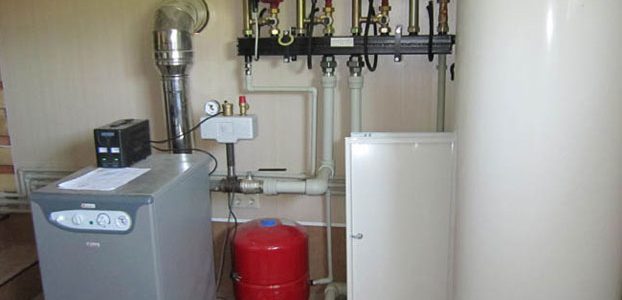
Install underfloor heating, hire an expert
When it comes to heating houses and apartments, a trend that is constantly growing is underfloor heating. This procedure makes it possible to heat the rooms or, in some situations, just reheat the room. The material to be purchased must be of high quality, use hot water pipes that are specifically intended for installing underfloor heating. The fact that the floor covering goes above it does not leave much room for improvisation, because any subsequent repair can cost a lot. The method of calculating the required length of pipes for heating the house is based on determining the heat losses of the building. The whole calculation is similar to how it is done when installing a radiator. The recommendation would be not to use the odocative method. A central water heating system or electric heating can be used for heating. In order to avoid any confusion, the entire system must be designed by an expert and designed according to the situation on the ground. The installation can be done in the
Recommendations for installing underfloor heating
Since the height of the underfloor heating installation is 10 to 12 cm, this means that the joinery should be raised from the slab just that much. It follows from this condition that underfloor heating is easier to install in the construction phase than in finished buildings. This height accommodates the base, pipes, leveling layer and finishing coating. Styrofoam in combination with reinforcing mesh or ready-made styrotherm plates with pipe channels can be used as a base. Ceramics, marble or granite are recommended as the final substrate for underfloor heating because these materials are very good conductors of heat. Also, two-layer or three-layer parquet can be installed. Parquet made of solid wood is not recommended, as it can cause it to crumble and thus cause the parquet to split. The recommended temperature of the supply line for underfloor heating is 35 to 40 degrees, which gives us an optimal temperature of about 28 degrees on the surface of the floor itself. Floor heating is excellent if the energy source is a heat pump that has good utilization at low temperature modes.
Why is installing underfloor heating a good idea?
Underfloor heating is increasingly seen as a cost-effective way of heating different rooms in the house. In addition, it is invisible and does not affect the appearance of the room in the same way that a radiator would. In addition, it requires less maintenance and care for efficient operation. Practical use is also an attractive option for homeowners. The main advantage of underfloor heating compared to radiator heating is that it requires a much lower water temperature (maximum 40 degrees), but also that it does not take up space and the walls remain free. Also, the floor distribution maintains the temperature for a long time, which means that 10 hours can pass without turning on the boiler to reach room temperature.
Are there disadvantages of underfloor heating?
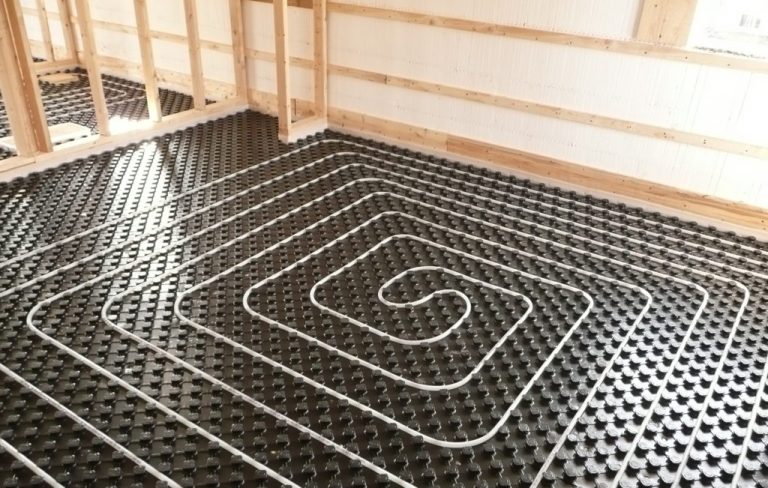 Floor heating Of course, there are also certain flaws, but those flaws are only conditionally speaking, everything depends on the case by case. Floor heating is more inert than radiator heating. Since floor heating works at lower temperatures (up to 40 degrees Celsius, while radiator heating works at temperatures up to 70 degrees), and since the floor heating pipes are hidden under the floor, it takes a longer time for the room to heat up. This can be a problem in the morning, so the best option is not to turn off the floor heating during the night, but to reduce the desired temperature in the rooms. Therefore, underfloor heating is not a good choice for facilities that are heated occasionally, such as utility rooms, rooms in commercial buildings that are used only occasionally, and the like.
Types of floor heating
Floor heating can generally be divided into two categories – water and electric. Electric is simpler and cheaper to install. Instead of pipes through which hot water circulates, and for the heating of which a special separate system is required, with electric underfloor heating, a very thin electric panel is placed under the floor, similar to an electric cover, and the whole system is controlled by a thermostat and timer. Lower initial costs and simple installation may sound tempting, but this type of heating is only suitable for smaller apartments or rooms that are heated occasionally. A large apartment would very quickly nullify modest initial investments through bills, because unlike a TA stove, underfloor heating must work during the day when electricity is more expensive, and at night when electricity is cheaper, the heating works at a lower capacity or not at all.
Electric floor heating
The principle of operation is based on heating a large area of the floor to a low temperature. This ensures even heating and ideal heat distribution in the room. Electric underfloor heating provides a pleasant feeling with minimal costs. Unlike other systems, energy losses caused by ventilation or poor insulation are minimized. Energy is used to heat the surface of the floor instead of the air, which cools much faster. It has been proven that compared to wall panels, electric underfloor heating provides the same feeling of comfort with 2-3°C lower air temperature, which leads to savings of 5-10% in energy consumption. Thanks to the thermoaccumulation of heat in the floor, depending on the purpose of the room and the quality of the insulation, several hours may pass before the system is switched on again for reheating. With the use of programmable and remote-controlled thermostats, this feature of electric floor heating comes to the fore. In the period when you are not staying in the heated space (working days, going on vacation or on a trip, on weekends – heating of business premises) or at night when the need for heating is reduced, the system works in temperature maintenance mode. The floor heating is activated according to your needs, the temperature rises when you stay in the space, thus saving up to 25% of energy.