Why is it necessary to replace the clutch set?
Replacing a faulty clutch set allows the car”s power transmission to function smoothly. The main function of the clutch is to coordinate the operation of the engine and transmission, i.e. by transferring power from the engine to the transmission and further to the drive wheels. That connection is made through a friction pad that wears out over time and is no longer able to perform its function. A worn clutch slips and is unable to transfer engine power and start the vehicle.
When is it time to replace the clutch set?
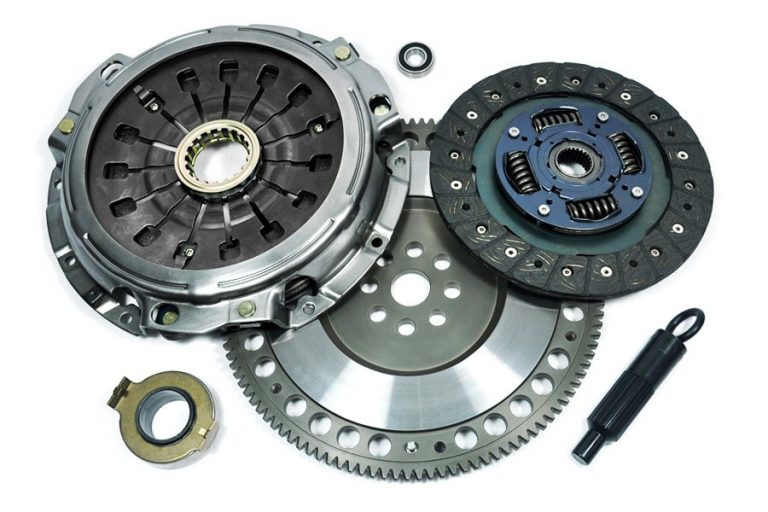 Replacing the clutch set The replacement period for the clutch set of modern cars is usually around 100-150,000 kilometers, but it can last much shorter, which mostly depends on driving habits. If you release the clutch very slowly or too suddenly, hold the clutch at a traffic light, on a hill, sign when you start, you shorten the life of the plate. Clutch longevity is most affected by: driving style, vehicle overloading, correctness of other power transmission parts (druck bearing, basket, clutch cable, floating flywheel). It is recommended that when replacing a part of the clutch, the entire set must be replaced because it is likely that the other parts of the set are at the end of their working life, and that you will soon visit the service center and pay again for the not so cheap operation of removing the gearbox.
How to recognize that the lamella is slipping?
Lamela will not fail suddenly. You will have enough time to notice that something is wrong. Those who drive lightly, without a load and on the plain, often do not notice anything until they have the opportunity to accelerate sharply when overtaking or driving uphill. The symptoms of a bad lamella can be varied, depending on its condition. In the beginning, they are mild and almost imperceptible, and then they become more and more noticeable and dangerous in some situations – overtaking, joining the highway… After the first mild symptoms start, the plate will show faster and faster that it is time to replace both the plates themselves and for the complete replacement of the clutch set. The reason is simple – the more it slips, the more it overheats and wears out faster, so it slips even more and thus enters a real spiral of destruction. Of course, some drivers delay the replacement for a very long time for financial reasons. They drive carefully, without sharp accelerations, avoid sharp climbs and climbing the curb. And so until driving becomes literally impossible.
Can I replace the clutch set myself?
If you don”t have a suitable tool for removing, mounting, holding and lifting anything and everything, a channel or a jack to lift the whole car, knowledge and experience – you will struggle so much that our suggestion is to leave the replacement of the clutch set to a professional. Also, there is the fact that you can do something wrong, so savings can easily turn into agony and much higher costs. Post the required service on bellcom.rs and compare the received offers.
Is it necessary to replace the clutch set?
Like many auto parts, the clutch is a consumable part that must be replaced from time to time. Over time, the lamella wears out, i.e. the friction linings on it. When the lamella is worn, it is difficult to achieve efficient power transmission between the engine and the gearbox. How long the clutch lasts depends on a lot of things, primarily on the driving style. Even the notorious floating flywheel won”t cause a problem ahead of time if the ride isn”t crazy. In principle, factory clutches can last between 150,000 and 200,000 kilometers. Replacement clutches are usually of lower quality and their replacement interval will be shorter. The practice is to replace the entire set of clutches, because a problem with one of these parts usually implies future problems with the others. Since replacing the clutch set is not a simple procedure, replacing the complete set saves on labor costs and multiple trips to the service center.
What is a floating flywheel?
A floating flywheel is the most common problem in modern diesel vehicles. Some manufacturers have floating flywheels in gasoline engines as well. Other problems related to the floating flywheel are related to knocking and ringing when driving, starting/stopping, sudden acceleration, etc. The floating flywheel consists of several components, the two main ones being the fixed part of the flywheel and the floating part of the flywheel (plates that transmit power from the engine to the clutch set, and the latter to the gearbox). A floating flywheel can also have a so-called the “pilot bearing” that comes with the flywheel, and if it is on the crankshaft, it is bought separately. The floating flywheel has the task of reducing the vibrations and shocks it suffers during movement, changing speed and engine braking, and directing them to the crankshaft and gearbox, which enables easy speed changes of the vehicle.