The importance of flat roof waterproofing
Among builders, water is considered the greatest enemy of every residential and commercial building, where it can get into in two ways – intentionally and unintentionally. If the waterproofing of the flat roof is not done well, the main problem that the owners and users of the building will face is the appearance of moisture, which then turns into mold, as a result of water penetration and the difference in temperature between the two environments. The flat roof is the part of the building that is by far the most water-stressed. Previously, bitumen was almost exclusively used for its waterproofing, over which the very popular concrete or coolir slabs on a base of sand, gravel, crushed stone or ceramic tiles were laid as the final layer, and in some cases only bitumen was left. However, by using it, it was observed that this material is structurally sensitive to natural temperature cycles, i.e. it reaches its melting point when hot and becomes brittle when cold. In addition, the sandy substrate also turned out to be unsuitable because it favors the sprouting of weeds that create a very strong and branched network of roots, which is disastrous for the bitumen. All this required the development of a new technology of waterproofing flat roofs and the introduction of new materials that will effectively solve this problem, so a method of installing a single-layer roof membrane was devised.
Flat roof waterproofing – which material to choose?
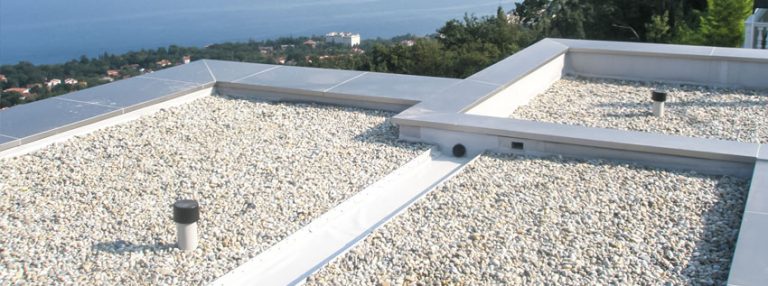 Waterproofing of a flat roof Any concrete surface at least three months old is a suitable substrate for waterproofing a flat roof. If it is about the restoration of old existing waterproofing, such surfaces require mechanical rough and fine cleaning in order to remove even the smallest impurities and remove any irregularity. Waterproofing of roofs is the protection of the roof against the penetration of water and moisture into construction objects. Given that the materials for waterproofing roofs have become very widespread over time, a large number of materials have recently been researched and tested. It should be emphasized that the most common cause of roof damage is unprofessional or poorly installed waterproofing. There is a possibility of installing materials on the roof that is installed for a completely different purpose, even though it is a waterproofing material. Many products are declared as waterproofing material and not all of them can be used for all purposes, so it is very important to be familiar with the material and the effect of water on waterproofing, the process of preparing the substrate for making waterproofing, the process of installing the material on the roof, etc.
Waterproofing of a flat roof with cement coatings
The waterproofing of a flat roof that is made with classic black insulation or is newly made is solved by using different materials, and one of the recommended ones is a two-component cement-polymer coating. Cement-polymer coating is extremely elastic, so it can withstand high and low temperatures, it is characterized by stretchability. For the sake of additional strengthening of the waterproofing coating itself, it is recommended to reinforce the trivet with cloth. These reinforcements are most important to be done at the sub-wall joints and around the drain. If there is an existing bitumen insulation, it must be checked and any existing damage repaired. Also, before applying the coating, the entire surface is coated with a layer of bitulite. The material is prepared by mixing the liquid and powder components with a mixer until the material is completely homogenized. The coating is applied with a taper brush in two layers, with a time gap of 6-8 hours between coatings. Between the layers, ie. in the first coating, while it is still fresh, immediately during its installation, Trevira cloth is dipped in order to reinforce the coating.
Bitumen-based flat roof waterproofing
Bitumen-based waterproofing belongs to the group of the most widespread waterproofing materials because it does not rot, has a supporting layer of glass veil or polyester felt, with plastomers and elastomers. The upper surface of the tape is sandblasted or covered with PE film, and the lower side has a coating of PE film that serves as a protective layer of the tape in the roll. Watertightness of the entire surface can be achieved by gluing, welding strips with overlap and smoothing the overlap. During professional installation, it gives a more even connection and a more homogeneous layer structure, thus greatly facilitating the contractor”s work. Waterproofing of a flat roof made with bitumen strips can last fifty years or more. The key parameters for quality execution are the correct foundation of the structural assembly, the correct choice of waterproofing tapes. Maintenance and occasional periodic inspections are also of great importance.